Should We Try to Persuade
Tuesday, March 21, 2017
The strongest argument I've heard in favor of maintaining links with Trump voters is the possibility of persuasion. It goes something like this: since our aim to limit/rectify the damage of the Trump presidency, then the pragmatic thing to do is to preserve communications with Trump supporters so that we can slowly work to bring them around. In addition, if we break off contact, then we close off any opportunity for Trump supporters to recognize their mistake. In effect, we are doing them further harm and making it less likely that Trump will be blocked/defeated in the future. Further, by retreating into a social world in which only Trump opponents are welcome, we are creating a similar epistemic bubble to that which conservatives have created for themselves, and which has done so damage to them and to our shared social world.
So according to this argument, by ending contact with Trump supporters I hurt myself (through epistemic closure), the person I care about (by not helping them see their error), and the world (by making it less likely that Trump voters will defect).
Let me take these out of order. With respect to hurting "the world": it makes the personal far, far too political. Close personal relationships with someone - especially a family member - should not be political, but based on mutual respect, a shared history, all those ephemeral ties that bind people together. To say that I must maintain an emotional connection to somebody for the sake of politics seems to me to corrupt the very essence of that relationship. You're saying that "be horrified by this person, but out of political calculation keep talking to them anyway."
With respect to hurting myself by creating an epistemic bubble: I can easily find out what wingnuts are thinking without having to personally associate with any of them. The internet is a thing. And there are plenty of professional and non-intimate social settings where I will be forced to interact with these people.
With respect to the person I am hurting - well, how much exactly am I supposed to bear in order for a person to have a chance to see the error of their ways? I mean, if my mother wants to send me an email or a message or a letter apologizing for her behavior, she can do that, and I'll probably read it. But the question I keep asking is - how likely is it that a person is really going to change their mind about this? And if I keep associating with them, what motivation do they have to do so? Aren't I tacitly condoning their moral horror by acting as if it never happened?
This last calculation is a difficult one, which is why I get why some people want to hang in there a bit longer, to give the other person a chance to see the light. But for me, that's minimizing the consequences of this election, and what is says about the people who voted for Trump. It's not up to me to do anything more for them. I have no interest in being yet another of their victims.
A Difficult Dilemma
Tuesday, February 14, 2017
After the election, I broke off relations with my mother, as well as with my former stepmother (who was a virtual 2nd mother to me when I was younger). It was one of the most difficult decisions I've ever made, and I've continually re-examined that decision without changing my mind. I thought it made sense to explain that decision here.
I want to begin by saying that I do not judge anybody for making a different calculation than I have. Morally speaking it's a very grey area, and different people are going to give each of these premises different weight, and also reach different conclusions. What I'm explaining is MY logic when applied to ME.
The first step in my reasoning is this: voting for Trump for President in 2016 was an evil act. Now generally I think it's difficult to attribute moral responsibility to a voter for the consequences of his vote - after all, we can't always tell what these candidates are really like, or predict with confidence what they'll do once they're in office. But I think that the Trump candidacy is kind of unique, in that his campaign was manifestly evil. I don't think there's much doubt that he campaigned as a candidate of white nationalism, or that he was patently unqualified for the office, or had an authoritarian temperament, had no respect for democratic norms, and that he's an outrageous liar and sexual assaulter. The evidence in each instance is pretty overwhelming - you don't have to be living in the liberal media bubble to reach these conclusions. All you had to do was to believe the things that he said.
But wait a second, says my invisible interlocutor - what about the other candidate? What if I think she was a threat to democratic stability, a corrupt criminal who would subvert the republic to feather her nest. On this point I have to say that there is FAR less evidence to support these propositions, and there is also the fact that Hillary Clinton was First Lady and a very influential figure in the Clinton White House for 8 years - without any of these dire outcomes, or any scandals involving her that amounted to anything. I would also say that the worst case scenario for both candidates made this election between a) a potential crook & tyrant, and b) a potential crook. That is not a hard choice. Finally, I'd argue that any seamy behavior you might have gotten in a Clinton administration would not remotely outweigh the fact that Trump is utterly incompetent to hold office (ZERO RECORD OF PUBLIC SERVICE!!!!), especially when it comes to foreign policy, and quite explicitly played footsie with some of darkest impulses in American social life. Hillary Clinton did none of that - she was a totally boring conventional liberal Democrat. And given that the House wasn't going to switch parties, a vote for her would be a vote for the stalemated status quo. So from a risk-avoidance perspective, voting D for President was the safest choice.
A second argument that might be made is that said Trump voter might vote not because of any qualities that Trump might have, but because they were pro-life, or wanted tax cuts, or believed in smaller government, or whatever garden variety conservative policy position you hold dear to your heart. With Trump in the white house, you get conservative policy outcomes, and you wouldn't with a Clinton white house.
This is a very plausible-sounding argument, but doesn't really cut any ice with me either. Bracketing my opinions on those issues, what it really boils down to is "I care more about abortion/tax cuts than I do about democracy/a qualified officeholder/racism/etc." You might, just might, be able to make an argument about abortion - if you really thought that it was murder - but to push the priority of that issue to that extreme it would also require you to say that women who had abortions and the doctors who committed them should be convicted of manslaughter at minimum. And if THAT is your opinion, then you are once again falling into the morally unacceptable category, since now you're saying that you believe that your fellow citizens (and friends and loved ones of mine thank you very much) should be imprisoned because they think that human rights kick in at around 7-8 months rather than 3 weeks. As for the other policy areas - sorry, but there's no way you can believably claim that tax cuts outweigh democratic rights or social equality for minorities. So what the vote for Trump really means it that you don't think democracy/racism/sexism MATTER. That the rights of your fellow citizens are simply of no concern to you (which also sort of undercuts your abortion argument, now that I think about it).
Okay so if we grant for the sake of argument that voting for Trump as a morally dubious act, that next get us to the far more contestable proposition: that because someone I care about voted for Trump, I should break off contact with them - that it's a fundamental betrayal of my relationship with a person, so much so that it makes further association impossible, just as one is not morally required to accept that a lover in a monogamous relationship has been unfaithful. In short, the person I cared about isn't the person I thought they were. They've become abhorrent to my eyes. And the closer the relationship to the person, the worse those feelings of betrayal.
I want to make clear that this is not about forgiveness. To forgive, the transgressor must first acknowledge that they have committed a wrong. If my Trump-supporting family member were to write me and say "oh my god I've done a terrible thing please forgive me" I would probably do so. I say "probably" because this was a decision with one's eyes very much open. There wasn't much doubt about the person they were voting for. However, I believe in the principle of charity so I'd probably end up forgiving.
But this isn't what we're talking about here - we're talking about a situation in which the other party continues to assert that their decision was morally praiseworthy, or neutral, or none of my business. That I should be indifferent to their evil action. We're also not talking about an immoral action - a simple personal bad - but something that does active, willing harm to other people. (And no, it doesn't matter if they think it's harm - it's that I think it's an active harm that's the salient point. That's one of the reasons that I can't impose my rationale for all this on other people, and say that they have to break up with their loved ones too).
The argument against my position is that I should not let differences about politics interfere with an otherwise solid relationship with a close friend or family member - that we have to accept political differences, even profound ones. I don't accept this argument, because there are always going to be outer bounds. What if a family member commits pedophilia, and refuses to acknowledge wrongdoing. Am I required to still engage with them? Too extreme an example? Okay, let's say that they knowingly concealed pedophilia by a third party, in effect enabling it, and defend their actions by claiming that they were being loyal/protective of someone close to them? I hazard to say nobody would blame me for deciding that this family member had become complicit in evil acts, and to refuse to accept those acts as long as they continued to defend them.
Again, one might assert that pedophilia (or protecting a pedophile) is not equivalent to voting for Trump. To which I respond - well, now we're just debating where the line is. You've already abandoned the idea that one "always forever" accepts the actions of a loved one by recognizing that s sufficiently evil act (in the absence of contrition) absolves me of my moral obligations.
Okay, this blog is already going on too long, so I'll continue it another time!
Well here are
Thursday, February 02, 2017
Like many bloggers I fell out of the habit. I suspect Facebook played a role, as did complacency (and a measure of frustration) during the Obama administration. After 2011 it was clear that little more that was productive could be expected from the Obama years, and so it was safe to take a step back from politics and tend to our own gardens.
I'm not sure whether I'll make a new habit of posting regularly in this space, but for the time being there are thoughts I need to sort out for myself, and writing is (for me at least) the best way to do so. I do not know if I will have any readers in this space, but I'm not terribly concerned if I don't.
So here we are, in a time of great doubt about the future of the republic. It is unclear whether the constitutional order will survive the pusillanimity of the conservative movement or the bungling authoritarianism of the new president. I find myself in the rather strange situation of being far more calm about this situation than most. Many of my friends and colleagues have become obsessed with political news, breathlessly consuming all of the many outrages. I've been oddly detached, since I've always spent a lot of time paying attention to politics and have gotten used to maintaining a certain distance from the froth of the day. You have to pick your moments, and buffer yourself a bit, or risk utter exhaustion and moral paralysis.
Having said that, it's quite clear to me that my self-imposed hiatus from political life has to end. I'm not quite sure in what capacity I'll become involved, or to what degree, due to the practicalities of my professional life and because politics can be all too consuming. Of course, there are times when we can't afford the luxury of remaining aloof from politics, when it demands everything of us that we're capable of giving, and I'm beginning to fear that this is one of those times.
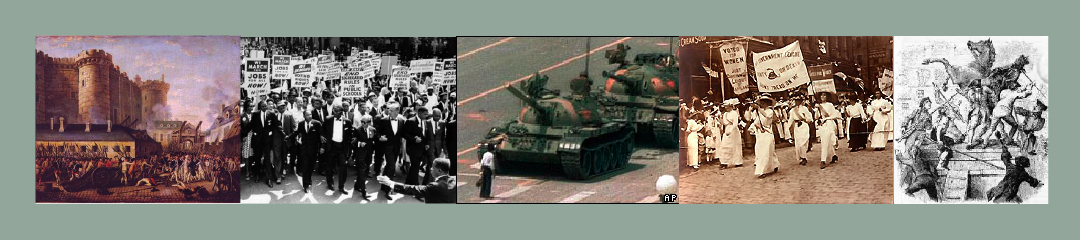
The inspiration for this blog's title may be sadly appropriate. The French Revolution was no time for focusing on our private affairs either.
Congratulating Myself & Horrified By It
Wednesday, September 02, 2015
This.
I can't find the exact place I wrote about this phenomenon, but I know I started talking about it a few years ago. I've thought for a long time that the conservative movement's electoral power is largely based on white nationalism. However, the "browning" of America would make this a very dangerous political strategy over the long term, not just for conservatives but for the future of American democracy. When 90% of the population is white, a moderate form of white nationalism might be consistent with democracy. However, if only 50% of the population is white, then white nationalism can easily lead to calls for disenfranchising non-whites (see: the American South, 1877-1965). The growth of Latino and Asian population in the U.S. present conservatives with the choice of either a) altering conservatism so as to moderate its white nationalism so it can win minority votes, or b) suppressing the votes of non-whites. Given the current power structure of the conservative movement & the psychological profile of its leaders, I suggested that conservatives would consciously or unconsciously select option b. I hadn't considered BooMan's "stupid party angle" - that a reliance of white nationalism would also encourage conservatives to abandon reason as well as democracy - but the basic outline of the argument is the same. Coupled with an incompetent political press corps and swing voters who don't (won't?) accept how radical the Republicans have become - well, let's just say I think we could be in a lot of trouble.
What Hamilton a modern liberal?
Friday, June 26, 2015
Of course not. Nobody serious, including Ron Chernow, thinks that he was. Look, I can appreciate
William Hogeland's frustration with the Jefferson-Hamilton debate, and totally agree that we can't project our modern political divisions onto the founding generation. On the other hand, America is a Founding-obsessed country and we have to accept that fact. It might be annoying to scholars, but U.S. politicians and activists are going to continue to identify themselves with major historical figures in order to legitimate their policies. This is particularly important for liberals, who want to change things.
Hogeland is correct that Hamilton's involvement in the Newburgh conspiracy was stupid. And there is plenty of evidence that Hamilton wasn't much of a small-d democrat. However, when one looks at the total package of policies that Hamilton argued for, and his overall vision for American society, we see a capitalist, socially mobile, industrial society based on free labor; a country with a strong military and robust national powers. By comparison Jefferson's vision of a rural society of yeoman farmers and a weak state doesn't look all that attractive, especially when you consider Jefferson's complicity with slavery. So the question isn't really whether Hamilton was what we would call a liberal or not, but whether he was a
modern. And by all reasonable accounts he most certainly was.
On another note, Hogeland trots out the tired idea that the nationalists were out to crush populist reforms. Oh boy, here we go with Beardian analysis of the critical period again. Here Hogeland is falling for the very mistake he criticizes others for - trying to slot previous generations into contemporary contexts. It's important to recognize that in evaluating historical figures & events we understand the set of problems they faced
as they understood them. The nationalists were concerned that the republic was going to collapse into class conflict within states and territorial rivalries between states. This was a perfectly reasonable fear. Let's assume for the sake of argument that Shays rebellion was a major factor at the Convention & during the ratification (this is disputed by historians). To smear the nationalists as anti-democratic presumes that 1) democracy as we know it was much of a norm (it wasn't - the U.S. in 1789 was one of the most democratic regimes on earth), and 2) their evaluation of the "populist" legislation directed at capital was motivated by class interest. However, the problem with Shays Rebellion (and what scared the hell out of the country's leaders) wasn't the policies that the insurgents were proposing so much as the fact that
they led an armed rebellion on a state capital and the national and state governments were impotent. The critique of republics was a tendency towards instability and disorder, which could ultimately lead to tyranny. The founders were worried that if they didn't make reforms the republic would collapse into a bunch of petty tyrannies. And they were probably right to do so.
On the Possible Demise of a Symbol
Tuesday, June 23, 2015
I grew up under the confederate battle flag. Although I moved around quite a bit as a young man, it wasn't until I was in my twenties that I lived in state where it wasn't prominently displayed. It was everywhere you looked. And as a young man I didn't think much of it. I was distinct among many of my peers in that I considered it a good thing that the South had lost of the civil war, and I always understood that the War had been about the preservation of slavery. Maybe that was because I grew up in areas that were (by regional standards) fairly cosmopolitan, or because my parents were from the North, but then that didn't save many of my friends from falling prey to the glamor of the Lost Cause. The power of place is quite extraordinary. After a few decades good northern liberals can find their children becoming confederate sympathizers, and even detecting more than a bit of drawl in their own speech.
However, despite my resistance to pro-confederate propaganda, it took a very long time for me to link it to the stars & bars. I'm therefore somewhat sympathetic to those who are confused by the strenuous calls to expunge the battle flag from public life. If you don't see a necessary connection between the War to Defend Slavery and an idiosyncratic southern symbol, then it's hard to see what gets people to riled up. Of course, if the symbol is so innocuous it shouldn't inspire great resistance to its elimination, but people's views aren't always very coherent so I'll leave that be.
It took me a long time to realize that rather than a harmless symbol or a minor issue, the confederate flag is a gratuitous insult to the millions of people whose ancestors suffered under a system of oppression
and still do. Despite the fact that I was (and am) a liberal, I still needed to be educated on this matter. It's no surprise then that unreflective southern conservatives (something of a triple redundancy) should take so long to come around.
I'm hopeful that the awful events in Charleston will finally result in the confederate battle flag disappearing into history. I hope that in a few decades it is as anathema to display that symbol as it is to wear the swastika. But I also hope that liberals realize that it will take a very long process of cultural education to persuade southern society that they have anything to be ashamed of. Getting rid of the battle flag would be an important victory, but the forces of evil that wield such influence in the South have suffered much more colossal defeats in the past and refused to give up the struggle for white supremacy. It's a siege, not a battle.
Times Change, You Better Change Too
Tuesday, December 16, 2014
If human history is any guide, Vladimir Putin's foreign adventures are plausible, perhaps even admirable. Adopting the standards typically applied to historical figures, Putin successfully established Russia's influence in its "near abroad" and even made a significant territorial acquisition. If he'd been ruling in the 16th century, he'd probably be considered a success.
Unfortunately for Putin, he's living in the early 21st century, and it's becoming increasingly clear that his political approach is
kind of a disaster. You see, there's a reason why there haven't been a many major changes in the political boundaries of states in the last 50 years, with the notable exception of states growing smaller ( crack-ups & secessions like Yugoslavia or Eritrea) and a couple of fairly equitable mergers (Yemen & Germany). Outright annexations of neighboring territory - which we used to call conquest - has happened much since WWII.
And why is that? There are lots of reasons, of course, but to me one of the more salient is that in the modern world
conquest is stupid. Look at Putin - he's wrecked his economy and has politically isolated himself. The rise of nationalism has made direct occupation of a foreign population totally counterproductive - you're never going to get a return sufficient to pay for the costs of occupation and your restive, probably very unproductive captive work force.
These days the smart imperialists have relied on establishing client states instead - intervening to install friendly governments with at least a patina of legitimacy. That's what the U.S. tries to do, and even THAT really doesn't work that well (see: Iraq, Afghanistan).
So, sorry notsorry Putin, I'm afraid that your anachronistic policies are resulting in a well-deserved comeuppance. There's 99 things about the modern world that is depressing, but the goofiness of foreign conquest ain't one of 'em.
 <$BlogRSDUrl$>


